


War and the Wild: The Impact of Armed Conflict on Biodiversity and Ecosystem Conservation and Mitigation Strategies
Abstract
The loss of biodiversity and the degradation of ecosystems are often acutely linked to armed conflict. Although studies of war have typically described the human and political consequences, this study provides a review of the ecological aspects of conflict, synthesizing examples of conflicts from global biodiversity hotspots. We identified direct effects of armed conflict—deforestation, habitat destruction, chemical defoliation, and wildlife harvesting—and indirect effects, including weakened governance, displacement, and resource extraction. Our review determined that while the direct effects of conflict are the most obvious effects on the ecology of biodiversity hotspots, it is often the indirect effects of conflict brought on by the collapse of governance and weakening of social order that drives long-term biodiversity loss. Case studies have also suggested that recovery and resilience are possible in post-conflict landscapes through Indigenous land management, use of protected areas, peace-building and longer-term reconstruction efforts that emphasize the need for stewardship.
In a nutshell:
Armed conflict directly destroys ecosystems through deforestation, habitat loss, chemical defoliation, and wildlife exploitation.
Indirect effects—like governance collapse, human displacement, and over exploitation of resources—often drive long-term biodiversity loss.
Ecosystems can recover: Indigenous land management, protected areas, and post-conflict restoration efforts can help rebuild ecosystems and safeguard biodiversity.
1 - Introduction
1.1 - Armed Conflict
The International Committee of the Red Cross (ICRC) defines armed conflict as a clash between state armed forces (international armed conflict) or between state governmental authorities and organized armed groups within a state (non-international armed conflict). Situations of internal disturbance and tensions (like a riot or protest) are not constituted within this definition (European Parliament, 2023).
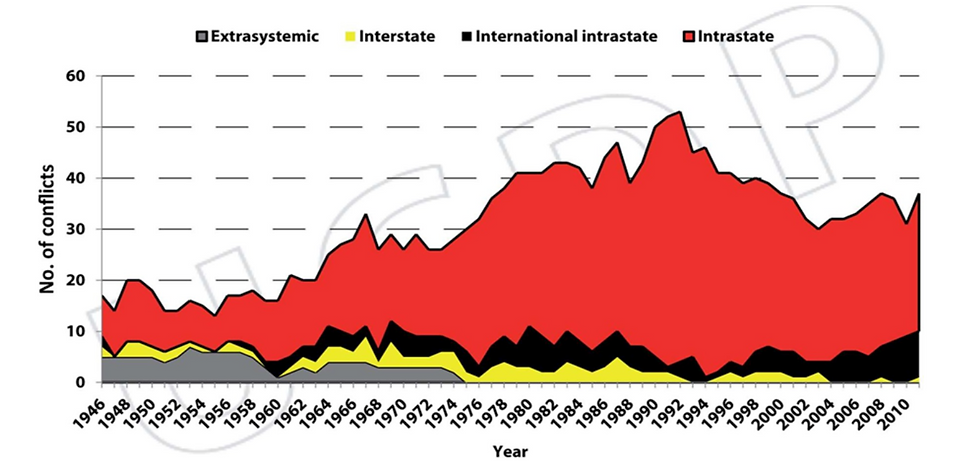
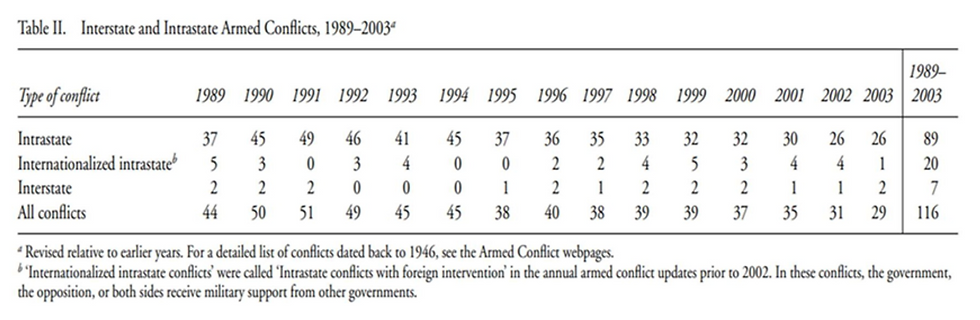
Since 1946, the end of the Second World War, researchers have documented 229 armed conflicts across 148 countries. Of these armed conflicts, the overwhelming majority have been intrastate conflicts (Figure 1) —wars fought within a country— with only seven interstate conflicts fought between states between 1989 and 2003. The late 20th century saw only a decline in classical wars up until 1989, while by 2003 the world had reported only 29 conflicts in 22 countries, the lowest number of armed conflicts since the early 1970s (Table 1). At that time, the probability of a given country being caught up in war had reached the lowest point since the early 1950s, giving rise to cautious optimism for enduring global peace (Eriksson & Wallensteen, 2004).
However, in the past several years, declines have set in. By 2024, there were 56 active armed conflicts globally -the highest number since the end of the Second World War. Conflict has also been more likely to draw in several nations, with 92 states engaged in conflict outside their own borders, the highest ever recorded since the Global Peace Index (GPI) has recorded data. Many conflicts that were considered minor confrontations, such as in Ethiopia, Ukraine, and Gaza in 2019, have become full blown major wars (Institute for Economics & Peace [IEP], 2025).
The human cost was horrific. In 2023, as many as 162,000 people died in conflicts, the second highest yearly war-related deaths recorded in the last 30 years. The wars in Ukraine (83,000 killed) and Gaza (~33,000 killed) accounted for around three-quarters of this estimate, while the level of displacement hit record levels with around 110 million displaced refugees globally. As of now, sixteen countries host more than half a million refugees each (IEP, 2025).
Thus far, we have focused our discussion on the human consequences of armed conflict -the deaths of individuals, communities, and political systems. Considering that armed conflict has considerable and pernicious effects on societies, the discussion of the human factor is an obvious requirement; deep scars are often left in societies by armed conflict. Often neglected is not the impact on people, but the harm to biodiversity due to this conflict. Armed conflict does not only rob lives, it disrupts and destroys ecosystems, often permanently. When biodiversity is diminished, the first to suffer are, inevitably, human beings themselves (Wirtu et al., 2025).
For many years, discussion of armed conflict has concentrated on human suffering, dislocation of people, and breakdown of governance. However, it is equally necessary to shift our focus towards the environmental impacts caused from warfare. Destruction of habitats, displacement of species, and contamination of soil and water are not an afterthought. They make up the total impact of armed conflict. The ecological damage caused by armed conflict potentially undermines the systems that sustain life on Earth, even after peace has been declared (Wirtu et al. 2025).
In this paper, we review the ecological dimensions of armed conflict, integrating evidence from biodiversity hotspots to examine how conflicts lead to biodiversity decline, and the mitigation strategies for this damage and decline.
2 - Biodiversity and Human Wellbeing
For decades, the pursuit of human wellbeing (HWB) has driven the fundamental objectives of governments and international policy bodies within the context of sustainable development. This path encompasses education, health, and environmental quality, yet it showcases ignorance towards the potential links between biodiversity and HWB (Naeem et al., 2016).
Biodiversity is typically defined as the diversity among living organisms, including diversity of species, genetic, functional and phylogenetic diversity, and the ecological complexes they form (Cardinale et al., 2012). Despite its complexity, global studies have documented significant declines in biodiversity across ecosystems (Mace et al., 2012). These declines matter because people depend on ecosystems, and ecosystems depend on processes such as nutrient cycling, primary production and biomass regulation to create ecosystem services. We rely on these ecosystem services for survival and wellbeing: they provide clean water, good soils, fisheries, timber, and cultural resources (Cardinale et al., 2012; Smith et al., 2013).
There are two different approaches to the biodiversity-HWB connection. Some argue humanity and economic development improve aspects of human wellbeing, but they have also historically diminished biodiversity. Land conversion to agriculture, overexploitation of natural resources, and pollution and the global trade of commodities, such as coffee, sugar, and fish, has left biodiversity destruction as collateral damage in the pursuit of human development (Mace et al., 2012). This can be shown as:
Human development (↑) Human well-being (↑) Biodiversity (↓) [↑=Increase, ↓=Decrease]
A more recent perspective considers biodiversity as essential to the foundation of well-being, and by providing a range of positive contributions to ecosystem functions – soil productivity, water purification, climate regulation, cultural services - biodiversity directly supports human societies (Naeem et al., 2016). This can be shown as:
Biodiversity (↑) Ecosystem functions/services (↑) Human well-being (↑)
Figure 2 demonstrates this interdependence by showing the contrasting conditions that describe two possible development pathways: the resulting conditions of ecosystems which are degraded and show instability and low well-being, and the conservation of biodiversity which leads on to resilient ecosystems and strong well-being. The framework reiterates that biodiversity is not only an environmental issue, but the environmental determinant of health, security, and prosperity for human societies.
Recognizing this link is important for sustainable development because continued biodiversity loss will result in a "biodiversity - well-being ratchet" that allows short-term small gains in human survival, while negatively affecting the ecological foundations that are essential for human well-being, additionally reducing prospects for long-term prosperity. Investing in biodiversity produces resilient ecosystems that underpin human well-being and the ability to withstand shocks.
Thus, protecting biodiversity is not only about saving physical species; it is, at its core, about protecting the conditions to live well (Naeem et al, 2016; Mace et al, 2012).

3 - Impacts of Armed Conflict on Biodiversity
For more than sixty years, armed conflicts has threatened ecosystems and wildlife in over two-thirds of the world's biologically significant areas (Gaynor et al., 2016; Hanson et al, 2009), with impacts ranging from more direct (tactical) and indirect (non-tactical) disruptions to the ecological balance in various manners (Figure 3).

Direct impacts are those that arise from military actions or actions proxies for military actions. Military actions that use explosives, landmines, and chemical weapons directly kill wildlife. Protected areas, which used to be wildlife refugia, are now sometimes used as military bases or as military corridors, these actions not only degraded habitats but also increased hunting pressure on protected wildlife. In some cases, wildlife is used to feed combatants or fund armed groups. All of these direct impacts leave long-term scars on ecosystems and wildlife populations , which threatens species' ability to survive in the wild and reduces the capacity of a habitat to recover (Gaynor et al., 2016).
Indirect impacts arise from the wider societal and economic effects of conflict. During conflict, wars reduce governance and institutional capacity and therefore the ability to conserve the environment, which in turn reduces environmental regulation enforcement and leads to the withdrawal of international support. Conflicts lead to large population displacements, and for refugees the reliance on natural resources and a likelihood to hunt, fish, and exploit forests increases (Gaynor et al. 2016). Conflict disrupts economies, and as a result people may turn to alternative livelihood options that rely on natural resources, leading to over-exploitation and misuse of resources in the form of mining, logging, and unsustainable agricultural practices. Indirect pathways of impacts from conflict frequently exacerbate the limiting effects of direct actions and demonstrate the complicated relationship between human interactions, conflicts, and biodiversity loss (Gaynor et al. 2016).
3.1 - Direct and Indirect Impacts
3.1.1 Direct Impacts
3.1.1.1 Forest Loss
The most frequently cited and important among many measurable direct effects is the loss of forests that degrades habitats, decreases biodiversity, and weakens forests' benefit to society (Gaynor et al., 2016; Westing, 1971; van Etten et al., 2008).
Forest loss due to armed conflict means the death or removal of trees and vegetation due to military activities that are not just because of deforestation for a strategic advantage (e.g., bombing, burning, herbicide use) (FRA 2020). This loss does not just result in the removal of physical habitat of innumerable species, but it also negatively impacts ecologic processes like carbon storage, soil stabilization, and water regulation so that recovery in forests affected by armed conflict will be a slow and arduous process (Gaynor et al., 2016; van Etten et al., 2008).
Westing (1971) examined forest losses in South Vietnam associated with U.S. military activity during the Vietnam War. Through field observations, interviews with military officials, and conservative aggregate volume estimates for timber losses, he found that U.S. military operations had clear-cut more than 6.5 billion board feet of trees (approximately 47 million m³). More than 6 million acres—around 20% of the country’s forest cover—were treated with herbicides such as Agent Orange, resulting in up to 80% tree mortality. Figure 4 illustrates the areas subjected to United States aerial herbicide spraying missions between 1965 and 1971 and the resulting transformation of dense forest into barren land, emphasizing the widespread scale of chemical defoliation and the severe ecological transformations caused by these operations. Beyond herbicide spraying, extensive bombing operations and bulldozing further devastated the landscape, clearing areas comparable in size to the state of Rhode Island. These cleared lands were subsequently overrun by invasive bamboo rather than native vegetation, further impeding ecological recovery. Ultimately, Westing concludes that any meaningful recovery would depend on careful forest inventory and long-term restoration efforts.
Likewise, Van Etten et al. (2008) analyzed the environmental impacts of the armed conflict between Turkish Armed Forces and the Kurdistan Workers’ Party (PKK) in southeastern Turkey in the early 1990s to assess the use of forest burning in the counterinsurgency campaign. To determine forest burning and evacuation patterns in Tunceli, van Etten et al. (2008) used remote sensing, demographic data, eyewitness accounts (Box 1), and human rights reports. They found that in 1991, the Turkish army used a field domination strategy that deliberately burned forests from military helicopters to eliminate guerrilla cover. The authors demonstrate that there were over 1,500 village evictions in 1994 alone, and that village evictions and destruction peaked in 1993 and 1994 (Table 2). The researchers note that as much as 25% of the forests in Tunceli were burned during military campaigns. In the local reports, evidence and accounts of regional skies blackened by smoke persisted for days or more. Van Etten et al. (2008) concluded environmental destruction was not incidental but rather a deliberate military program designed to reorganize and reshape the conflict zone.


3.1.2 Indirect Impact
Among many wildlife declines that occur during armed conflict or wartime, a great many are not from war activities in a direct way, but from people, due to population movement into wildlife areas and the mining or resource extraction that comes from a collapse of social systems. During the course of a war or armed conflict, wildlife markets increase, as well as human migration from armed conflict areas into or near wildlife areas. The most common indirect impact of armed conflict is local people and refugees engaging in poaching of local wildlife (Gaynor et al., 2016).
3.1.2.1 Poaching
Poaching is the illegal capturing and killing of wild animals often motivated by financial profit, survival needs, or the market demand for animal parts such as ivory, hides, or traditional remedies. De Merode et al. (2007) studied the impacts of civil war on the protected area Garamba National Park in the Democratic Republic of Congo. They analyzed the efficacy of Garamba National Park protection activities and long-term patrols, with respect to illegal bushmeat extraction pre-, during, and post-conflict periods. They used long-term park patrol records as a measure of protection activity and assessed shifts in bush meat hunting-as monitored in urban by military officers and rural markets by village chief's— in the context of the differences in enforcement, as well as local socio-political structures governing the bush meat trade.
They found that the rise and fall of illegal hunting, particularly in urban markets, showed unexpected patterns (Figure 5): urban bush meat sales increased dramatically during the conflict (Period 2) even though park patrol frequency remained similar to pre-conflict levels (Period 1). Sales then declined in the post-conflict period (Period 3) even as patrol frequency significantly decreased due to park staff being disarmed. Rural bush meat sales, however, remained constant throughout all periods. They argue that the surge and subsequent decline of illegal hunting were primarily influenced by changes in local social institutions regulating natural resource use —specifically, the shifting control of the urban bush meat supply chain by military officers-- rather than solely by anti-poaching patrol frequency. The authors concluded that enforcement is useful (increased patrols reduced sales within periods) but was inadequate during conflict, particularly given the much higher absolute poaching levels. Conservation strategies, therefore, must also mobilize traditional and local governance methods such as the village chief's role in the rural market to fortify protect-area resilience and cost-effectiveness during political instability.

The scale of natural resource extraction increases during times of war, so wildlife is subject to increased hunting pressure. Brito et al. (2018) examined 10 species of large vertebrates in the Sahara-Sahel to examine this effect and used mapping to correlate conflict event data, human movements, species distributions, and field data to help identify threats. They reported that instances of illegal killings of wildlife greatly increased along with armed conflict. The number of conflict events in the Sahara-Sahel has skyrocketed by 565% post-2011 and conflict events now account for 20% of overall conflicts in Africa and nearly 5% of global conflicts. The largest driver of wildlife population decline was human killings, followed by oil and gas exploration.
To illustrate the outcomes of armed conflict on wildlife populations, Brito et al. (2018) studied Addax populations in Niger between 1966 and 2000. They found that Addax killings have increased since 1997, with escalation beginning in 2011 and reaching particularly high levels after 2015. Similarly, in Mali the number of reported elephants killed increased for three years starting in the early part of 2012. It is evident from this pattern of population loss in species like the dorcas gazelle and elephant, that loss of population is associated with increased conflict. Similarly, wildlife massacres are occurring in the Congo where Beyers et al. (2011) investigated the impact of the civil war on forest elephant populations in the Okapi Faunal Reserve (RFO). They used distance sampling data collected in 1994–1995 (pre-war) and 2005– 2007 (post-war) and found that the elephant population declined by 48% (3151) in the reserve. The decline was driven by increased ivory poaching and hunting because human-wildlife proximity increased in wartime. These findings further showcases that natural resource extraction and wildlife decline during wartime expose the failures of social systems that provide fundamental resources to the population.
![Figure 6: Distribution of extinction risk factors and demographic trends in three threatened vertebrates from the Sahara-Sahel. [only showing 2 species] Left column: local distributions of A. nasomaculatus in Niger (Termit/Tin-Toumma), Gazella dorcas in Libya, and Loxodonta africana in Mali (Gourma), and of conflict events (including attacks/battles and violence against civilians) after 2011, as well as major roads, oil, gas, populated places, and mining facilities. Right column: temporal evolution of population size of A. nasomaculatus in Termit/Tin-Toumma and of cumulative number of G. dorcas and of L. africana illegally killed in Libya and Gourma, respectively, and number of conflict events in each country. Black horizontal lines represent periods of increased conflict (from Brito et al 2028 figure 3).](https://static.wixstatic.com/media/795db1_cb599de20e4241038f8688c9ea51a482~mv2.png/v1/fill/w_980,h_624,al_c,q_90,usm_0.66_1.00_0.01,enc_avif,quality_auto/795db1_cb599de20e4241038f8688c9ea51a482~mv2.png)
4 - Key Insights
Armed conflict has deep, pervasive impacts on biodiversity, affecting ecosystems both directly and indirectly. While it is becoming increasingly clear that direct effects of war (i.e. bombing, chemical defoliation, clear-cutting of forests) can damage ecosystems, it is often the indirect effects through failures and breakdowns of social systems and governance systems that lead to long-term biodiversity impacts (Gaynor et al., 2016). Gaynor et al. (2016) conducted a global literature review of 144 case studies to determine how armed conflicts affect wildlife. Using content analysis, they identified 24 pathways linking conflict to wildlife outcomes: 10 tactical (direct) and 14 non-tactical /indirect (Table 3). They found that the majority of direct effects such as military tactics and supporting military activities like bombing, habitat destruction, and killing wildlife for food or ivory were one of the pathways for biodiversity loss, but the indirect effects—non-tactical pathways such as weakened law enforcement, loss of institutional support, interruption of conservation initiatives, mass movement of people, and increased demand for natural resources from an economic collapse- were more detrimental to biodiversity than direct effects. Gaynor et al. (2016) argue that while military tactics can have immediate tangible harm to wildlife, indirect effects from the breakdown of institutions, increased pressure on the ecosystem from refugees, and collapsed economies have wider impacts on biodiversity that are interconnected and potentially longer lasting. Because military tactics result in immediate damages, conservation needs to include efforts to halt the immediate damages, but conservation must also include rebuilding institutions.

De Merode et al. (2007) has highlighted that bushmeat extraction in Central Africa was dependent on the quality of governance prior to, during, and after violence. In rural markets governed largely by traditional authorities, bushmeat extraction levels were fairly stable, whereas urban markets were deemed to have failed governance structures entirely. In the absence of effective governance, these markets experienced unsustainable increases in illegal bushmeat sales, pointing to the ability of fragile institutions to drive ecological harms that outstrip the limits imposed by even strong anti-poaching law enforcement measures (figure 5).
Beattie et al. (2023) also supports the idea that the quality of governance affects ecological sustainability in war zones. Indigenous peoples have provided better environmental outcomes within biodiversity hotspots than other lands above and beyond the degenerative effects of armed conflict. In conflict-affected regions, Indigenous Peoples’ lands contained substantially more ecologically intact areas than other lands. Specifically, 25% of Indigenous lands qualified as natural land—defined as areas with a Human Footprint score of 3 or less on a 0–50 scale, indicating minimal human disturbance—while 7% were classified as Intact Forest Landscapes (IFL).
In contrast, other lands exposed to conflict contained only 10% natural land and 2% IFL. IFL are large, continuous forest areas with very limited human influence (Beattie et al. 2023). These findings provide evidence of how resilient forms of social institution and traditional land management can mitigate the worst aspects of war for ecosystem sustainability.
Overall, these results show that while direct conflict actions produce immediate harm to the ecological world, the resilience of social and governance systems will usually lessen indirect impacts. As such, conservation interventions in conflict-sensitive areas need to support conservation objectives, simultaneously engaging both ecological resilience, local institutional strength and traditional land management in order to bring about recovery and the sustained protection of biodiversity.
5 - Mitigation Strategies to Lower the Impacts
This paper highlights that the indirect ecological impacts of armed conflict frequently exceed the direct impact. Therefore, post-conflict conservation and restoration strategies must involve comprehensive, multi-scalar frameworks that include governance, conflict-aware planning, and ecological recovery. Below are organized strategies to mitigate the impacts.
Promote environmental governance and ensure institutional resilience
Armed conflict disrupts environmental governance systems, often resulting in long-lasting environmental harm. To address this, we have to:
Embed conservation into post-conflict rebuilding: Efforts to conserve land will need a level of environmental protection embedded in peacebuilding agendas, infrastructure rebuilding, and land-use planning (Loucks et al., 2009).
Restore institutional governance from the community level up: Conservation institutions can be renewed by restoring the community governance systems that permit the community to ensure that traditional leaders effectively govern natural resources (De Merode et al., 2007; Beyers et al., 2011).
Global funding and technical support: States affected by armed conflict should receive financial and technical support from the international community to support their reestablishment or to implement conservation and restoration programs, like the Kibira Peace Forest in Burundi, that share a sustainable peace agenda with ecological restoration (Figure 7).
Conflict-aware conservation planning
Conservation in conflict zones has to be adaptive and pragmatic such that it recognizes the challenges of instability.
Green military planning: Military forces should be educated on the ecological effects of their actions. Regulations and frameworks must be binding and hold most militaries accountable to mitigate deliberate or unwitting destruction of ecosystems during periods of war (Meaza et al., 2024).
Peace parks and no-go zones: Areas that may have unintentionally gained protection during a conflict, such as the Korean Demilitarized Zone, should be identified and maintained as permanent wildlife areas as a means of securing biodiversity for the long term (Kim et al., 2013; Martin & Szuter, 1999).
Biodiversity recovery and ecosystem restoration
The first priority must be ecological recovery, which means repairing the habitats and revitalising the populations of species that have been degraded due to prolonged conflict
Ecosystem restoration activities: Large scale reforestation efforts, invasive species removal and habitat rehabilitation should be undertaken with local help of displaced or returning communities (Loucks et al., 2009).
Wildlife population recovery: Population restoration, species reintroductions, and anti-poaching efforts need to be prioritised for keystone species and large mammals that have suffered disproportionately to hunting and habitat loss (Brito et al. 2018).
New opportunities for restoration: New biotechnologies including genetically modified plants may increase reforestation and ecological resilience in the worst affected landscape (Häggman et al., 2013).

6 - Conclusion
This paper has demonstrated that armed conflict affects biodiversity in several ways. Specifically, the destruction of habitats, deforestation and chemicals used for wars affect ecosystems and biodiversity. In addition, the weakening of governmental and social systems raises the probability of environmental degradation (Gaynor et al., 2016; de Merode et al., 2007). However, nature can sometimes show resilience even amidst war. Protected sites, indigenous land management, and post-war peacebuilding initiatives demonstrate that ecosystems can be rehabilitated by integrating environmental aspects of reconstruction (Beattie et al., 2023). By pointing out these two contradictory facts—devastation and opportunity— the paper concludes that nature restoration in war-torn countries would require more than one approach (Häggman et al. 2013; Gaynor et al., 2016). Restoration will involve rebuilding institutions, empowering communities and employing biotechnological tools to enable restoration at a larger scale. While conflict can undermine biodiversity and sustainability, opportunities exist through ecological restoration and community stewardship, both of which can transform fragile environments into an enduring and resilient ecosystem.
Citations
Armed conflict: A glossary of terms - European Parliament. (n.d.-g). https://www.europarl.europa.eu/RegData/etudes/ATAG/2023/757582/EPRS_ATA(202 3)757582_EN.pdf
Beattie, M., Fa, J. E., Leiper, I., Fernández-Llamazares, Á., Zander, K. K., & Garnett, S. T. (2023). Even after armed conflict, the environmental quality of Indigenous Peoples’ lands in biodiversity hotspots surpasses that of non-Indigenous lands. Biological Conservation, 286, 110288. https://doi.org/10.1016/j.biocon.2023.110288
Beyers, R. L., Hart, J. A., Sinclair, A. R., Grossmann, F., Klinkenberg, B., & Dino, S. (2011). Resource wars and conflict ivory: The impact of civil conflict on elephants in the Democratic Republic of Congo - the case of the Okapi Reserve. PLoS ONE, 6(11). https://doi.org/10.1371/journal.pone.0027129
Biodiversity Loss and its impact on humanity. (n.d.). https://www.researchgate.net/publication/225283251_Biodiversity_loss_and_its_impac t_on_humanity
Brito, J. C., Durant, S. M., Pettorelli, N., Newby, J., Canney, S., Algadafi, W., Rabeil, T., Crochet, P., Pleguezuelos, J. M., Wacher, T., de Smet, K., Gonçalves, D. V., da Silva,M. J., Martínez‐Freiría, F., Abáigar, T., Campos, J. C., Comizzoli, P., Fahd, S., Fellous, A., … Carvalho, S. B. (2018). Armed conflicts and wildlife decline: Challenges and recommendations for effective conservation policy in the sahara‐sahel. Conservation Letters, 11(5). https://doi.org/10.1111/conl.12446
Cardinale, B. J., Duffy, J. E., Gonzalez, A., Hooper, D. U., Perrings, C., Venail, P., Narwani, A., Mace, G. M., Tilman, D., Wardle, D. A., Kinzig, A. P., Daily, G. C., Loreau, M., Grace, J. B., Larigauderie, A., Srivastava, D. S., & Naeem, S. (2012). Biodiversity Loss and its impact on humanity. Nature, 486(7401), 59–67. https://doi.org/10.1038/nature11148
de Merode, E., Smith, K. H., Homewood, K., Pettifor, R., Rowcliffe, M., & Cowlishaw, G. (2007). The impact of armed conflict on protected-area efficacy in Central Africa. Biology Letters, 3(3), 299–301. https://doi.org/10.1098/rsbl.2007.0010
Eriksson, M., & Wallensteen, P. (2004a). Armed conflict, 1989–2003. Journal of Peace Research, 41(5), 625–636. https://doi.org/10.1177/0022343304047568
Gaynor, K. M., Fiorella, K. J., Gregory, G. H., Kurz, D. J., Seto, K. L., Withey, L. S., & Brashares, J. S. (2016). War and wildlife: Linking armed conflict to conservation.Frontiers in Ecology and the Environment, 14(10), 533–542. https://doi.org/10.1002/fee.1433
Globalpeaceindex2025.(n.d.-b).https://www.visionofhumanity.org/wpcontent/uploads/2025/06/Global-Peace-Index- 2025-web.pdf
(2020). Global Forest Resources Assessment 2020. https://doi.org/10.4060/ca8753en
Häggman, H., Raybould, A., Borem, A., Fox, T., Handley, L., Hertzberg, M., Lu, M., Macdonald, P., Oguchi, T., Pasquali, G., Pearson, L., Peter, G., Quemada, H., Séguin, A., Tattersall, K., Ulian, E., Walter, C., & McLean, M. (2013). Genetically engineered trees for plantation forests: Key Considerations for Environmental Risk Assessment. Plant Biotechnology Journal, 11(7), 785–798. https://doi.org/10.1111/pbi.12100
HANSON, T., BROOKS, T. M., DA FONSECA, G. A., HOFFMANN, M., LAMOREUX,J. F., MACHLIS, G., MITTERMEIER, C. G., MITTERMEIER, R. A., & PILGRIM, J. D. (2009). Warfare in biodiversity hotspots. Conservation Biology, 23(3), 578–587. https://doi.org/10.1111/j.1523-1739.2009.01166.x
Kim, K.-G. (2013). Conservation and management strategies. The Demilitarized Zone (DMZ) of Korea, 479–571. https://doi.org/10.1007/978-3-642-38463-9_10
Loucks, C., Mascia, M. B., Maxwell, A., Huy, K., Duong, K., Chea, N., Long, B., Cox, N., & Seng, T. (2009). Wildlife decline in Cambodia, 1953–2005: Exploring the legacy of armed conflict. Conservation Letters, 2(2), 82–92. https://doi.org/10.1111/j.1755- 263x.2008.00044.x
Mace, G. M., Norris, K., & Fitter, A. H. (2012). Biodiversity and ecosystem services: A multilayered relationship. Trends in Ecology & Evolution, 27(1), 19–26. https://doi.org/10.1016/j.tree.2011.08.006
Martin, P. S., & Szuter, C. R. (1999). War zones and game sinks in Lewis and clark’s west. Conservation Biology, 13(1), 36–45. https://doi.org/10.1046/j.1523-1739.1999.97417.x
Meaza, H., Ghebreyohannes, T., Tesfamariam, Z., Gebresamuel, G., Demissie, B., Gebregziabher, D., & Nyssen, J. (2025). The effects of armed conflict on Natural Resources and conservation measures in Tigray, Northern Ethiopia. International Soil and Water Conservation Research, 13(2), 463–474. https://doi.org/10.1016/j.iswcr.2024.11.004
Naeem, S., Chazdon, R., Duffy, J. E., Prager, C., & Worm, B. (2016a). Biodiversity and human well-being: An essential link for sustainable development. Proceedings of the RoyalSociety B: Biological Sciences, 283(1844), 20162091. https://doi.org/10.1098/rspb.2016.2091
Smith, L. M., Case, J. L., Smith, H. M., Harwell, L. C., & Summers, J. K. (2013). Relating ecosystem services to domains of human well-being: Foundation for a U.S. index. Ecological Indicators, 28, 79–90. https://doi.org/10.1016/j.ecolind.2012.02.032
van Etten, J., Jongerden, J., de Vos, H. J., Klaasse, A., & van Hoeve, E. C. E. (2008). Environmental destruction as a counterinsurgency strategy in the Kurdistan Region of Turkey. Geoforum, 39(5), 1786–1797. https://doi.org/10.1016/j.geoforum.2008.05.001
Westing, A. H. (1971). Ecological effects of military defoliation on the forests of South Vietnam. BioScience, 21(17), 893–898. https://doi.org/10.2307/1295667
Wirtu, Y. D., & Abdela, U. (2025). Impact of war on the environment: Ecocide. Frontiers in Environmental Science, 13. https://doi.org/10.3389/fenvs.2025.1539520



Comments